


What better way to mark England's first game in the World Cup than with a look at some patented football-related technology? In Networld Sports Ltd v Quick Play Sport Ltd [2026] EWHC 1295 (Ch), the Patents Court dismissed an appeal against a UKIPO decision that had upheld the validity of a patent for a portable sports goal. The judgment, handed down on 1 June 2026, offers a concise but instructive lesson in patent claim construction, novelty, and the risks of shifting your case between the appeal skeleton argument and oral submissions.
Kick off: Background to the Patent
EP 2 146 786 (the "Patent"), owned by Quick Play Sport Ltd., protects a portable goal designed for use in sports such as football or hockey. The Patent relates to a goal which, when assembled, places a frame under compression while supporting the goalmouth perimeter edges under tension. This arrangement delivers structural integrity to the frame without requiring large, rigid members for the base, goalposts and crossbar.
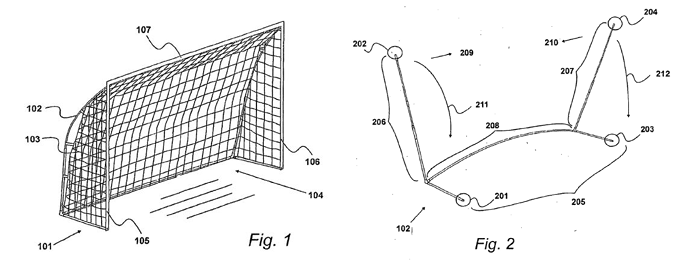
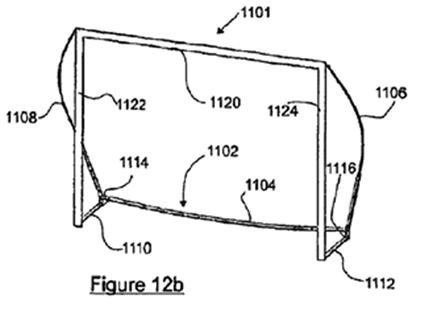
As shown in Figures 1, 2 and 12b below, flexible poles sit outside the goal's footprint and are bent inwards when the net is attached. The poles are therefore biased to spring outwardly, and it is this restoring bias that keeps the crossbar taut, maintaining the goalmouth in tension. Claim 1 of the Patent requires that the tops of the flexible poles that connect to the net are "biased apart laterally from a position relative to each other", whilst claim 10 of the Patent provides a slight variation, requiring that the poles "are normally biased apart from a position at which the frame is placed in compression".
Half time: Revocation proceedings
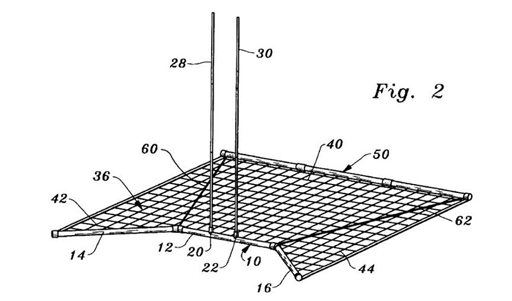
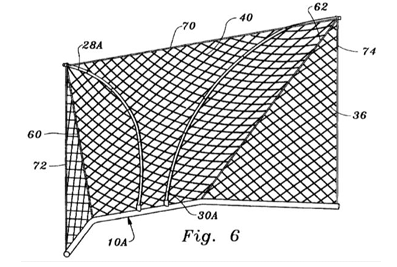
At first instance, Networld applied to revoke the Patent for invalidity, citing US 5 690 339 A (D1) as anticipating claim 1. D1 describes a collapsible sports goal with a frame and net, but its flexible poles sit inside the footprint of the goal and are bent outwards when the frame is assembled (see 28, 30 of Figures 2 and 6 of D1 below). That is, in contrast to the arrangement in claim 1, the natural bias of the poles of D1 is to return together, rather than to pull apart. In both D1 and the Patent, the net provides a force on the poles to hold them in a bent position, and as per Newton's third law, the poles exert an equal and opposite reaction force on the net.
The central issue during revocation proceedings was the construction of the final integer of claim 1:
"...wherein the first and second upper net connection points of the frame are biased apart laterally from a position relative to each other".
The Hearing Officer construed the term "biased apart laterally" as referring to the restoring bias of the upper frame connection points - that is, the reaction forces of the frame against the connected net that would try to move the upper frame connection points apart. He held that since the upper frame connection points of D1 are biased towards each other due to the restoring bias of the frame, rather than biased apart (laterally) as required by claim 1, D1 did not anticipate claim 1 and accordingly did not anticipate claim 10 for similar reasons.
Tackling the issues at appeal
In its written appeal case, Networld rejected the Hearing Officer's construction and argued that the source of the force causing the upper connection points of the frame to be "biased apart laterally" referred to the biasing force experienced by the assembled product as a whole (i.e. the forces present considering the frame and the net in cooperation), and not due to the frame alone. Under this construction, the goal apparatus of D1 would anticipate claim 1 since its poles also experience forces biasing its upper connection points apart (i.e. forces imparted by the net) when assembled.
The High Court judge agreed with the Hearing Officer's construction, confirming that it is the frame that is laterally biased apart according to claim 1, and dismissed the appeal. The judge noted Quick Play's submissions that this interpretation reflects the teaching of the Patent specification, as "the whole point of this invention is that the rear compression frame is what provides structural integrity by putting the goalmouth elements in tension".
Quick Play further succeeded on an additional point of novelty over D1, arguing that D1 does not disclose a frame "configured to support a pliable crossbar member in tension" between the upper net connection points, as required by claim 1. In D1, the cord-like crossbar (reference 70 in Figure 6 of D1) hangs between two fixed points under its own weight. The High Court judge held that the crossbar of D1 is not "in tension" due to the frame, because gravity alone is not the same as active tensioning by the frame. Instead, tension must be applied to the crossbar to give the goal as a whole structural rigidity; it cannot simply dangle under the tension of its own weight.
Procedural own goals
Interestingly, the judgment includes criticism of Networld's procedural approach to appeal proceedings. In its skeleton argument for the appeal, Networld described the case as turning on "a single short point... relating to the construction of a single integer of the claim", but then walked the judge through various provisions in UK and European patent law during oral submissions. The judge found this exercise unhelpful, noting that since Networld did not make any specific point in relation to these provisions, they could only keep them generally in mind.
Furthermore, the judge found that Networld's oral submissions differed materially from the written skeleton arguments. While its written submissions focused on the "biased laterally apart" point of construction as discussed above, the oral arguments pivoted to a discussion of balancing four forces within the assembled goal, which the judge did not find to be "at all helpful in reviewing the Hearing Officer's decision...".
The message is clear: on appeal from the UKIPO, the appellant should identify a specific error in the decision and present that error with precision. Walking a judge through first-principles materials not previously in play, without connecting them to a concrete criticism, is unlikely to satisfy the courts.
Final whistle
Although it's unlikely that anyone will be blowing vuvuzelas for this decision (aside from perhaps Quick Play), it serves to reiterate that novelty turns on what the prior art actually discloses in light of the claims as construed, not on whether similar forces or physical principles are used. Claims must be construed purposively in the UK, in context, and with reference to the specification as a whole. Finally, on appeal, moving the goalposts risks a penalty: you must aim squarely at the Hearing Officer's reasoning.
For Quick Play, the Patent survives intact on claims 1 and 10: its structural integrity, much like the goal it protects, held up under pressure.


