


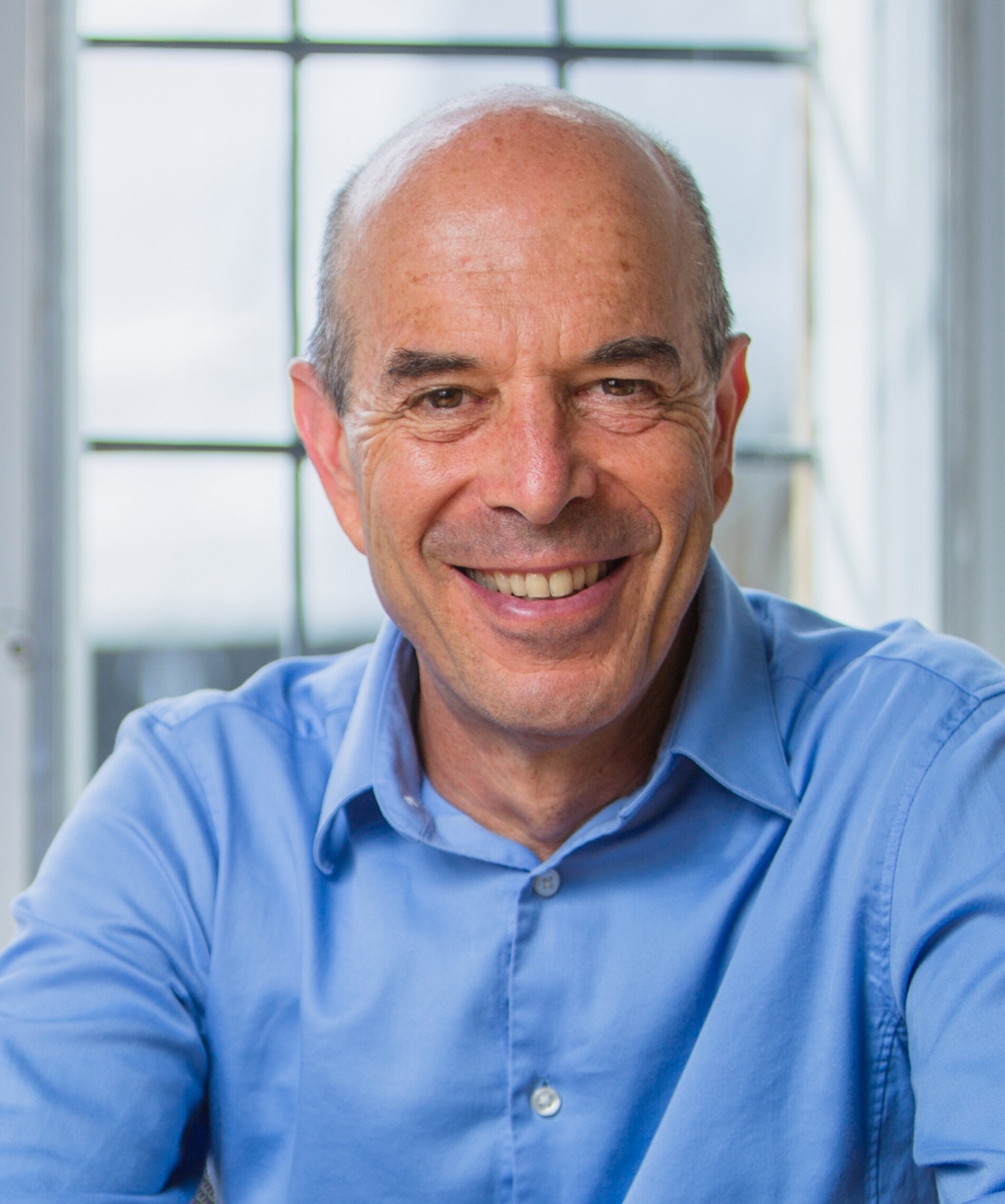
In Conversation With…Ian Goldin
Series 1: Podcast 1
Lucy Lewis: Hello, and welcome to the Future of Work Hub’s “In Conversation With...” podcast. I’m Lucy Lewis, a partner in Lewis Silkin’s Employment Team. In this podcast series, I will be hosting exclusive discussions with innovators, business leaders and thought leaders to explore their perspectives on the changing world of work.
The pandemic has accelerated longer term societal, economic and technological trends giving us a unique opportunity, a once in a generation challenge to re-think who, how, what and where we work. And I am looking forward to exploring what that means for the world of work with our guest speaker for this podcast, Professor Ian Golding.
Ian is Oxford University’s Professor of Globalisation and Development and Director of the Oxford Martin Programme on Technological and Economic Change. He also has a fascinating CV, including being the former Economic Adviser to Nelson Mandela and Vice President of the World Bank.
Welcome to our first episode Ian.
Ian Goldin: It’s a pleasure to be with you.
Lucy Lewis: So Ian, as you know, the Future of Work hub looks at future of work through the lens of longer term mega trends but we recognise that unexpected disruptions can have immediate and significant impact on the world of work.
We’ve all seen, most of us have experienced, that the current pandemic has accelerated change at what feels like a record level and we will obviously come to talk about the pandemic. But, before we do that, I wanted to just touch on some of those other underlying trends. Some of those things that have been shaping the world of work and having an impact over the past few years and decades.
World of work
So, if we leave the pandemic to one side, just for a moment, what do you think are the key trends shaping the world of work?
Ian Goldin: The seismic changes happening that have been going on really at an accelerating pace for the last 30 years, but it’s the rise of the digital economy, automation, robotics, artificial intelligence, machine learning, which has really brought these to the fore at a much at a much more rapid pace.
The main change I think is that a widening range of activities that were previously the preserve of humans, that now can be done by machines. Much more effectively, 24 hours a day, without having to be paid and without getting sick or complaining. And it is that encroachment on human activities, which I believe, is both accelerating and globalising which I think will be the biggest structural shift.
The second very big shift is that all our economies as they progress are going through a transition from first, agriculture, to manufacturing, and now services. And so, when you look around the world you see a growing share of economic activity in services. Less and less making things. Less and less atoms and more and more bits.
And so, we go from a physical world where we mainly are making, we’re mainly employed, we’re mainly producing. Products you can see that you can put on a shelf that you can manufacture in some way to products which are experiential. Products which are a service and many of these can be traded. Not all of them. You can’t trade having your hair cut for example, and it has to be done where you are. Experiencing live music. But many of the things, including I would suggest law, can be done at a distance and so it’s that which is transforming economies and as a bigger and bigger share of our economies becomes services, what those services are, who produces them and where they have produced them is shifting in a very radical way.
Lucy Lewis: Thank you very much.
Digital transformation
The first thing you talked about there was the digital transformation and I know that the Oxford Martin School has been responsible for some really interesting and notable research about disruption caused by digital transformation and there are some really eye opening statistics in that. I wonder if you could just briefly tell us what that research has shown?
Ian Goldin: Yes. I started the Future of Work Group in 2012, and it really has been at the forefront of thinking about what professions could be done by machines, where are the risks? It’s not predicting in saying it will happen. It’s saying this is a possibility. The technological capability exists for these sorts of tasks to be done by people and when most of the tasks that individuals do can be done by machines, we regard those jobs to be at risk. And in our calculation which got quite a lot of attention, something like 47% of US jobs are vulnerable to technological displacement over the next 20 years or so. About 40% of UK and European jobs, and a different share in other countries. So very significant.
Now whether this happens or not depends on many things. It depends on the politics. It depends on adoption rates, which are culturally and socially determined. And of course, it depends on the extent to which there is this determination to embark down this road and there has been a lot of resistance to it, as we have seen historically and as we are continuing to see today. But we believe it will happen.
And in countries that have rapidly ageing workforces, and I’m thinking of Japan, I’m thinking of China, a lot of East Asia, parts of Europe, this could well be a boom because labour forces are contracting very rapidly and so actually there is a great shortage of labour and this could lead to be a solution to some problems.
But in other places, including in the US which still has a growing population, but particularly in Africa and Latin America where you have a youth bulge, this poses very fundamental questions about where will employment come from? And it’s also the case that where the new jobs will be created is not the same place as the old jobs being destroyed and it’s this difference in geographical location that is often neglected in analysis.
Many people, I’m thinking of the McKenzie Global Institute for example, say less than 10% net of jobs are likely to be lost. In other words, there is going to be so much new job creation, the World Economic Forum thinks that there will be many more new jobs than jobs lost. And the OECD points to 13%. So, those numbers are very different from ours and part of the explanation is that we believe it would be very difficult for the people that are losing jobs, for example in the north of England and the mid-west of the US, in manufacturing, or call centres in India or the Philippines, to get to the new jobs. So, it’s different people in different places with different skills getting the new jobs and that really matters because that’s where the social dislocation comes.
The reason why so many people are vulnerable is that basically machines increasingly can do any rules-based tasks that doesn’t require dexterity or empathy with increasing effectiveness. And it’s not only in manufacturing production lines, it’s also in call centres where automated call centres are ready or getting better customer satisfaction scores than personal call centres. It’s in the back offices as you well know, in law firms, in financial firms, insurance, accounting and in many, many areas. And so, it is that dislocation that we’re pointing to which is very dramatic and will have a very significant impact we believe on many countries.
Lucy Lewis: Thank you, Ian. That’s fascinating and sobering in equal measure. If we turn to look at the pandemic. Because obviously the pandemic overlays all of these mega trends that we’ve been seeing, and we know that it has been accelerating trends, but it’s also been accelerating tension. Things that we might have predicted will take much longer to come to a head.
working from home
So, we’ve seen an acceleration of automation. We’ve been talking about that. But also, and very obviously the transformation of office space, an increasing amount of remote working, and those things are going to have an impact obviously on workers themselves, but they are also going to impact our cities and our towns. How do you see that playing out?
Ian Goldin: I think the pandemic will have a dramatic impact. It’s not starting any new trends but it’s very sharply accelerating them, intensifying them, revealing them. And it’s that which means that what many businesses are saying is what would have evolved over 10 or a 20-year timespan is now happening in the space of a year or two.
That poses enormous questions. At best, I think we’ll see 90% of people going back to their offices, but more likely 80 or 70% of people working more flexible hours and that’s going to have a fundamental impact, for example on property prices, on office prices. Our calculation is that it will take, if it was only 10% less demand, it would take 26 years for office space to catch up with current built premises.
So, it’s really quite fundamental, even these small changes, how they will impact on property prices. For example, offices. We see what some have called the retail apocalypse in central business districts or on high streets and that clearly is leading to a big fall out of many, many retail firms, we’ve seen in the UK, but even more dramatically so in the US and across Europe. And that’s going to, I think, lead to very big questions about where is the revenue base for cities - which mainly came from offices and shops.
It has very major repercussions for public transport systems. Already most of them were suffering dramatically, in debt, and this has now been compounded. So the real dangers that we get into a vicious downward spiral where services are cut, they become less clean, less reliable, less safe, we use them less, we have more cars and that would be extremely bad, particularly for low income people.
And what the pandemic has revealed generally is this great inequality between those whose incomes have been barely affected, who can work from home, who have space and privacy at home often see an improvement in their quality of life, less time commuting, more time at leisure and more time at home. More time to hear the birds sing and others who have to go to work because their work is physical, whether it’s in construction or in a hospital or in collecting garbage or whatever. And of course, they’re at greater risk.
The increase in unemployment, the increase in formality, in precarious work has been quite dramatic and of course we have also seen a very high correlation between minority groups, loss of jobs and also loss of livelihoods and lives, the incidents of COVID-19 has been so much greater on black, Asian and minority ethnic groups. And these inequalities have all been intensified.
So I think what we’re seeing with this, we saw it in the 2008/9 financial crisis, is that when we are hit by shocks it has a very different impact on different parts of the economy. It’s also likely to exacerbate the differences between different regions. For example, between the north of England and the south, between the metropolitan and the thriving parts of the US and the mid-west and similarly in Europe between the mega cities and the rest. So although it will lead to some dispersion of activity, mainly because there will be some lowering of income in urban areas as offices and shops decline and some growth in villages and commuter areas where more people spend more time and money, this doesn’t translate into much further afield dispersions. So, people aren’t going to suddenly start working in the north of England for example, or in the mid-west of the US. It’s not going to reverse the fortunes of places which have been suffering from significant declines. It is going to improve the fortunes of beautiful places which are an hour or two away from major cities. Because I think many people, many professionals, will go in a few times a week and therefore will want to be at that sort of distance.
So, in many ways it reflects these inequalities. It also intensifies the divisions between young and old. There has been enormous solidarity of the young for the old. in the UK and in the US the average age of mortality from COVID-19 is around 82 years old, and there is less chance of a school kid being killed by COVID-19 than being struck by lightning. And in the UK lightning is not very frequent. For a University aged person there is more chance of being killed in a car accident than being killed by COVID-19.
Young people are giving up their social lives, their education and their job prospects and inheriting a massive debt in order to keep the older generation alive. And it’s that solidarity which has been both remarkable but also, I believe is something we need to reflect very deeply on because it leaves very deep and lasting scars on young people. How society is going to reward them, how are we going to create a better prospect is I think the task ahead of us.
One good thing that the pandemic has brought, is I think a recognition, not only of our shared humanity, that risks can come from everywhere and therefore we need to care about other places, but also that Governments can do things that we thought would be impossible a year ago. The fiscal stimulus has been way beyond anything that previously would have been contemplated and so too has been the behaviour change. Telling people not to go to restaurants or football matches, to fly and so on.
So we know that Governments can do things when they want to and when they have to and the big question for the future is how is that going to translate into a different role of Government going forward and to ensuring that this is the pandemic to end all pandemics. It’s fundamentally transformed work, but is it fundamentally transform our societies too? and that, I would say, the Jury is out on.
Lucy Lewis: And actually, that last point, that idea of the global impact, the role of Government was something I wanted to pick up on, because we’ve been looking for a long time, lots of futurists, at the role of global dynamics. You know, and on the Future of Work Hub it was a significant trend. We were watching it closely. And now we’ve had this global pandemic…
Globalisation
I’m wondering what you think about how the global pandemic will impact global dynamics, globalisation more generally?
Ian Goldin: This is the most important question I think that has been starkly revealed. It was there before. We’ve seen it before in the financial crisis in other global risks in escalation of climate change and the need to do something about that. And this pandemic of course was entirely predictable. Many people, including I, in numerous books, and others have said it would happen. The surprise isn’t that it happened. The surprise is that we seem to be so unprepared for it. And that, I think, is the big question going forward.
The question in many ways can be thought about, are we in the First World War or the Second World War? As all the listeners will know, the First World War, although HG Wells had hoped would be the war to end all wars through very bad policies austerity, a downward spiral economically rising nationalism and protectionism led to an even worse war. But the Second World War in the midst of it, a new World Order was created. We’ve had the lasting peace in the sense of no more world wars, that was the achievement that was most important. But also, the creation of the Bretton Woods systems of the Marshall plan, of a global development agenda and coordinated multilateralism. That has to happen again.
Unfortunately the signs have not yet emerged that it is happening at the scale it needs to, but to stop another pandemic, to use this as an energising call to arrest climate change, and to deal with the other grave threats we face including nuclear and many others, we need to see this as a wake up call and this will take many forms.
The World Health Organisation which has responsibility to stopping pandemics has less resource than a major hospital in the UK, or the US Coastguard. And one has to ask oneself why if the chances of being killed by a pandemic are thousands of times greater than being killed in a military conflict. And this is certainly what emerges from intelligence agencies recommendations but also from people that know about pandemics, why do we allocate a tiny, tiny fraction of what we allocate to the military to stopping pandemics? Why do we have a NATO for the military and no equivalent with resources for pandemics?
And so, my hope is that it will lead us to recalibrate, to focus on what’s important, to empower the World Health Organisation. It needs to be reformed. It needs the resources. It needs the mandates from its owners which are our Governments to be able to stop pandemics in the future which it absolutely could do if it was properly resourced and had the authority to do so.
And similarly, for other international organisations. We don’t have, yet, an organisation to take such actions on climate change. We have an agreement but no international organisation.
On world trade, agreements are stymied, and reform of the World Trade Organisation is gridlocked.
In terms of finance, this has been a desperate time for developing countries. It is set back with sustainable development goals immeasurably. 125 million more people have been put into extreme poverty as a result of the pandemic leading to the collapse of global economic activity and with it, development. The rich countries have allocated over 12 trillion dollars for themselves in fiscal stimulus to support their workers in furloughs and so on. And less than 1% of this has gone to development. In fact, in the UK, our aid budget has gone down by about a third at a time when it has never been more desperately needed.
And so this really needs to be a time I think that we recognise that we, as a global community, can only be as strong as our weakest links and that we do think very deeply about solidarity within our countries, how it can overcome inequality and of course solidarity internationally. How we can overcome inequality globally which has been greatly widened by the pandemic.
Lucy Lewis: Thank you. Fascinating. Really interesting. Just a last question from me and one we’re going to ask all our guests on this podcast series.
Future of work
From a personal perspective, what do you think will be the biggest and most radical change for the future of work that we’ll take forward with us out of this pandemic?
Ian Goldin: I think for those of us who have been fortunate enough, and certainly academics are amongst them, not those that work in labs, but those like me that work on computer screens. We’ve been very fortunate to be able to work remotely and I think what this has done is enable us to take that forward much more rapidly.
So, I, for example, now I have a team of 10 young postdoctoral researchers, and I’ve never met seven of them, because I’ve recruited them all during 2020. And I wouldn’t have thought that was possible before, but it’s worked extremely well. Of course we would like to get together but I don’t think it’s going to be necessary in future to insist that people spend as much time as they would of physically together which will be, I think very good for people in terms of being able to recruit from a wider range of places, for peoples’ work life balances, looking after family or other needs. That has been an extremely positive development.
It poses risks. It questions why you would employ someone in a high income environment if you could get the job done from the other side of the world much cheaper. So, I think it’s going to pose all sorts of challenges but I think it is a great liberating force and I think we’ve seen the possibilities whereas previously the idea that people stay at home or don’t work might have been disregarded, but with some scepticism I think that now has been embraced and I do think that that is an important step forward.
Lucy Lewis: Thank you so much for joining us today Ian. It’s been really fascinating and thought provoking.
If you’d like to find out more about any of our discussion today, please go to www.iangolding.org where you can see Ian’s extensive publications including his current book Terra Incognita, 100 Maps to Survive the Next 100 Years. And we can look forward to your next book coming out, I think on the 13th of May, Ian, which covers a lot of the really interesting ground you were talking about in terms of the inequalities deriving from this pandemic and that’s Rescue: From Global Crisis to a Better World.
Thank you.
Ian Goldin: Thank you so much Lucy.
If you require this transcript in a different format, please contact info@lewissilkin.com
