


On Wednesday 3 December, the Advertising Standards Authority (ASA) published three fascinating decisions about ads in the fashion sector. These adjudications follow in the slipstream of the Competition and Markets Authority (CMA) investigations into ASOS, BooHoo and George at Asda, which we covered here, and the regulator's subsequent publication of guidelines about green claims for the fashion sector, which you can read about here. These latest ASA decisions show how the self-regulatory body is working to support the statutory regulator by 'seamlessly' applying its policy across the fashion sector. What's more, these three cases show how the ASA is using its much-vaunted Active Ad Monitoring system to target its resources at the issues that it deems important, and not simply pandering to the agenda set by competitors, the media or special interest groups.
Nike – Just don't do it!

Let's get off the starting blocks with Nike's paid-for Google search ad for "Nike Tennis Polo Shirts – ... Sustainable Materials." The ad linked to a product wall where some items carried a "sustainable materials" banner. The ASA questioned whether the unqualified claim of "sustainable materials" was misleading. The CAP Code requires that the basis and meaning of environmental terms be clear, and that absolute claims be backed by a high level of evidence, typically across the full product life cycle unless clearly limited. The ASA considered "sustainable" an absolute term liable to be understood as implying no environmental detriment over the product's life cycle. Although Nike pointed to recycled polyester content (at least 75% for the relevant polos) and cradle-to-gate data indicating reduced CO2 versus virgin polyester, the claim was not explained in the ad itself, and the substantiation did not demonstrate that there was no overall detriment across the full life cycle. The ASA therefore decided to uphold the complaint, finding that the ad breached rules on misleadingness, substantiation and environmental claims. Nike was told not to repeat the claim without clear qualification and robust evidence.
Don't shed crocodile tears for Lacoste.
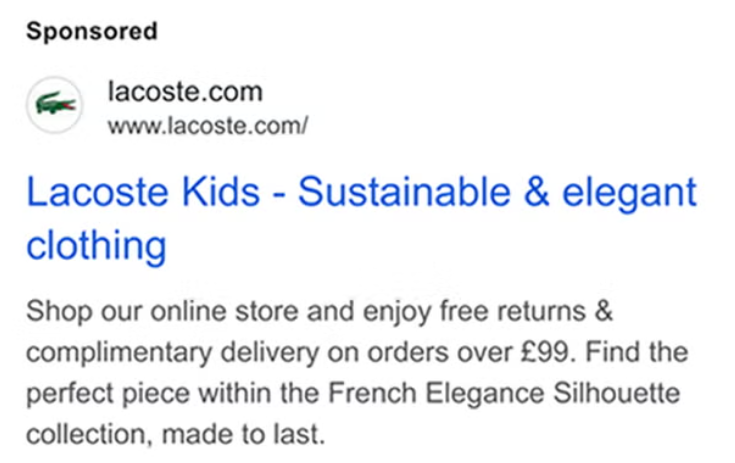
Next up is a paid-for Google search ad for Lacoste which stated, "Lacoste Kids – Sustainable ... clothing." The ASA asked whether the unqualified "sustainable clothing" claim was misleading. In its response, Lacoste cited a multi-year environmental strategy, high use of certified fabrics in the Kids range, and life cycle analyses indicating a reduction in environmental footprint for the 2025 season Kids collection versus the 2022 season. The ASA nevertheless found that "sustainable" was an absolute claim likely to be read as asserting no environmental harm across the life cycle. The comparison to prior seasons did not substantiate that absolute proposition, and the ad itself did not explain the basis of the term. It's therefore no surprise that the claim was found to breach the rules on misleadingness, substantiation and environmental claims. The ASA welcomed removal of the ad but instructed Lacoste to clarify the basis of any future environmental claims and hold high-level substantiation.
Cold water poured on Superdry's claims.

Finally, a paid-for Google ad for Superdry stated: "Sustainable Style. Unlock a wardrobe that combines style and sustainability ..." The ad was served via Google Performance Max, with landing pages varying by user journey. The ASA challenged whether the "Sustainable Style ... sustainability" claims were misleading. Superdry argued the ad highlighted products with sustainability credentials certified against Textile Exchange standards and that 64% of items purchased contained sustainably sourced materials. However, the ad deployed absolute "sustainable/sustainability" terminology without qualification. The ASA considered consumers would likely take the claim to mean that all clothing, footwear and accessories marketed in this "wardrobe" had no life-cycle detriment. Evidence of material sourcing and percentages, while relevant, did not establish that absolute proposition or address full life-cycle impacts. Superdry also acknowledged that full life-cycle information was not publicly available. The ASA therefore decided that the ad breached the CAP Code rules concerning misleadingness, substantiation and environmental claims. The ASA welcomed the ad's removal and instructed Superdry to clarify the basis and meaning of future environmental claims and hold a high level of substantiation for absolute claims.
AI-powered advertising is challenged by the ASA's own AI-powered enforcement.
The Superdry ruling underscores a central principle that runs through recent cases and guidance: automation does not dilute an advertiser's responsibility for the content of its advertising. Even where Google Performance Max dynamically determines targeting and landing pages, the advertiser is accountable for the claims, their qualification, and the underlying evidence. That principle mirrors earlier decisions and advice touching on different risks in AI-mediated ad delivery.
First, in the Stripe & Stare decision from March 2023, the ASA upheld a complaint from a member of the public that an image used in a campaign run through Performance Max objectified and sexualised the young woman depicted. The Performance Max system had automatically selected the image to be used in the ad from all those on the inner pages of the advertiser's website. The key point for AI use was explicit: regardless of automated assembly or placement, the advertiser bears primary responsibility for compliance. The fact that Google's systems selected or served the asset did not mitigate the advertiser's duties under the CAP Code. Transposed to environmental claims, Superdry shows the same logic: an AI-driven campaign cannot carry absolute "sustainable" wording unless the ad itself clearly explains scope and the advertiser holds high-level, life-cycle evidence.
Second, the Phlo Technologies ruling from July this year on dynamically generated Google Ads further illustrates the risks. In that case, a Dynamic Search Ad produced the headline "Weight Loss Injections," which amounted to prohibited promotion of prescription-only medicines to the public. The ASA again emphasised that the use of automated ad formats does not excuse non-compliance. In sustainability, similar generation risks arise: AI systems can create or place copy variants that inadvertently introduce absolute terms ("sustainable," "eco-friendly," "green") or strip necessary qualifications, thereby triggering the strict substantiation threshold seen in Nike, Lacoste and Superdry. We have also seen it in other contexts, where a restricted term has been used in an ad created using an AI tool for a product in a heavily regulated sector.
Third, CAP's advice on generative AI clarifies that the Codes are media-neutral and apply irrespective of how content is created. Where AI tools generate copy or imagery implying product efficacy or environmental performance, advertisers must ensure those impressions are accurate, not exaggerated by stylisation or model bias, and appropriately qualified. For environmental messaging, that translates into careful prompt design, controlled claim libraries, pre-approval workflows, and guardrails that suppress absolute terms unless life-cycle evidence and in-ad qualification are present.
Finally, the ASA's own Active Ad Monitoring system, which uses AI to identify potentially non-compliant ads, raises the enforcement stakes. The Nike, Lacoste and Superdry cases formed part of a coordinated sweep of environmental claims in fashion triggered by that system. In practice, that means AI-accelerated detection meets AI-enabled distribution: automated campaign tooling can scale risk as fast as it scales reach, while the regulator's AI can surface breaches quickly and systematically.
Taken together, the implications for advertisers using systems like Google Performance Max are clear. Environmental claims (and those in heavily regulated sectors like alcohol and gambling), must be engineered for compliance before they are handed to automated platforms. Absolute terms should be avoided unless supported by robust life-cycle substantiation and accompanied by clear, proximate qualifications within the ad itself. Copy variants and feeds used by AI systems should be constrained to pre-cleared language, with dynamic generation settings configured to exclude high-risk terminology. Product-level sustainability attributes require precise, product-specific claims tied to recognised standards, and those claims should not be extrapolated into broad, unqualified brand or range-level assertions. Across creative, targeting and placement, the advertiser remains responsible. And don't forget, the regulators' AI tools will be watching your AI-generated ads.

