


In September last year, we wrote about the first court appearance of three finfluencers whose trials are now scheduled to take place in the autumn of 2027, two years after their first court appearances. We noted that promoting financial products without authorisation is not just a matter of having your knuckles rapped by the Advertising Standards Authority but can also have criminal consequences. Breaching the Financial Services and Markets Act 2000 (FSMA) is punishable by up to two years' imprisonment, an unlimited fine, or both.
So, when the Financial Conduct Authority announced on Friday 20th February that seven different social media influencers had all entered guilty pleas at Southwark Crown Court to one charge each of illegally promoting high-risk foreign exchange trading schemes to their millions of followers, you might have expected substantial fines to follow.
But the fines imposed by the court on Lauren Goodger, Scott Timlin, and five other finfluencers were surprisingly small. For betraying the trust of their 4.5 million followers and promoting investments where the FCA has previously said that 80% of customers lose money, the total penalties of £21,769.04 were, frankly, derisory.
To make matters worse, these posts were made between 2018 and 2020. If justice delayed is justice denied, that's not great for the people who were foolish enough to follow the advice of these social media 'stars' into financial 'black holes'.
Modest penalties: Income v Fines and Costs Orders
Instead, the penalties bore no relation to the potential consequences these influencers' posts had on their followers. Lauren Goodger was paid £2,275 for four posts promoting "amazing deals", "free signals" and "consistent profits" to her 750,000 followers. She was fined just £3,750 and ordered to pay costs of £5,778.18. Scott Timlin, a.k.a. Scotty T from the 'reality' TV show Geordie Shore, boasted the largest following, at 2.7 million. He was paid £900 for three videos but received a fine of just £938 plus £1,000 in costs and a £93 surcharge.
The others were fined less than £1,000 each, with similar amounts in costs orders and surcharges of less than £100. One received a conditional discharge and another an absolute discharge. One now lives in Dubai, which some might say is punishment enough.
One person who saw the posts told the court she had lost £150 of a £250 investment. How many of their other 4.5 million followers suffered similar or greater losses? We will never know, but given that contracts for difference (CFD's) are high-risk derivatives that are often highly leveraged, investors can lose more than they invested. Even if just 2% of their 4.5 million followers lost an average of just £50 each, that would mean their total losses were £4,500,000. It's also hard to believe that the costs orders reflect the true cost of these prosecutions, so any shortfall will be met by taxpayers, including many who don't watch reality TV, don't speculate on foreign exchange and don't take financial advice from influencers.
Did Lauren Goodger really not know she was doing anything wrong?
The treatment of Lauren Goodger is the most troubling. The judge accepted that in 2020 and 2021 Goodger "didn't appreciate" she was doing anything wrong. This proposition deserves serious scrutiny, not least because we recall that ignorance of the law is no defence.
Goodger's history of CAP Code breaches suggests a pattern of conduct that makes any claim of naivety hard to believe. In October 2019, over a year before she made the forex posts that led to her prosecution, the ASA upheld multiple complaints against her in connection with her promotion of BoomBod weight loss products. The ASA found that her Instagram post, which featured an image of her holding BoomBod packaging with claims about "amazing results", breached the CAP Code in three respects: making unauthorised health claims; referring to a prohibited rate or amount of weight loss; and promoting a dieting product in an irresponsible manner. The ASA was particularly concerned that her photo appeared to have been edited to make her waist look artificially thin, concluding this was "particularly irresponsible in the context of an ad for an appetite suppressant that presented her as an aspirational figure."
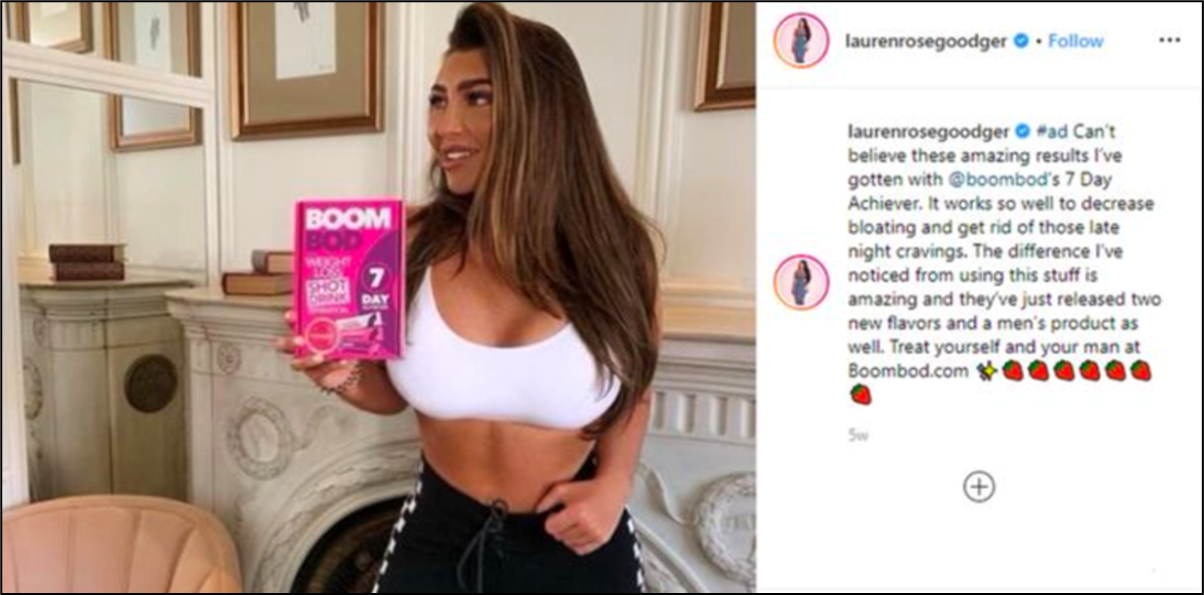
Then in August 2021, the ASA upheld another complaint against Goodger concerning Instagram posts promoting a foreign exchange trading tips service, albeit this was after the posts for which she has now been prosecuted.
But by the time Goodger was making the posts that formed the basis of her criminal prosecution, she had already had an ASA adjudication against her and should have been aware of the need for compliance with the CAP Code, which reflects the underlying FSMA requirements. It is hard to avoid the conclusion that Goodger undertook no due diligence about her legal or regulatory obligations before making any of these posts.
A missed opportunity
The judge lifted reporting restrictions, citing public interest because social media was "awash" with posts promoting similar trading schemes and there was "little indication of how they were controlled or regulated." That is precisely why these sentences represent a missed opportunity. The fines imposed are a fraction of what the influencers were paid for the posts in question and probably an even smaller fraction of what their followers lost.
If the courts are serious about protecting consumers from the risks of high-risk financial products promoted on social media, the consequences for those who flout the law must be meaningful. The ASA and the FCA can only do so much to protect consumers, and their efforts must be reinforced by the courts, who must provide the sanctions and deterrents. Social media platforms also have a role to play in protecting their users from financial scams, particularly in view of the current appetite for greater regulation of social media generally.
These small fines will do little to deter the next wave of finfluencers tempted by easy money from promoting forex trading schemes. The victims who lost their savings deserve better and the ASA and FCA deserve more support.


