What are the legal risks when AI use crosses the line into intellectual property infringement and how do we advise clients who are building or using AI-generated outputs to manage those risks?
The 2026 edition of the our AI Agenda conference took place on 16 September 2026. The event brought together business leaders, innovators and legal experts to explore the real-world challenges and opportunities of AI adoption. The conference session featuring Intellectual Property Partner Oliver Fairhurst considered the key IP risks relevant to generative AI use, and highlighted the ease with which AI tools can be used to both deliberately infringe IP rights and the ways that unsuspecting AI users may inadvertently infringe.
What is the IP legal framework relevant to generative AI?
The session opened with a recap of the various forms of IP rights relevant to the development and deployment of AI tools. This included discussion of:
The session then addressed the issue of copyright ownership of AI outputs; the question of whether AI model weights (being mathematical parameters learned from training data) may be copies of training data; and recent interesting case law from Germany which found that an AI tool infringed copyright where it could be shown it had ‘memorised’ song lyrics found in its training data and that these lyrics were retained in the models in reproducible form.
What are the risks of IP infringement when using AI tools?
Obvious infringement
Back in February 2023 (only a few months after the late 2022 launch of ChatGPT) we discussed the IP infringement risks of using AI-generated works. Our predictions in that article have largely been borne out in practice, and there are image generation tools that are now widely available that people within businesses will be using which make it fast and simple to copy and modify visual content. For example, at the conference we showed an example of something that might be generated by a marketing professional within a business, who might seek to combine brand assets with existing protected album artworks:
An example of existing brand asset combined with existing album cover.
An example of existing brand asset combined with existing album cover.
If used commercially, these AI-generated marketing images, deliberately created by our prompting, would infringe IP rights in the original album covers. Given the obvious derivation these types of infringement are likely to be caught internally within a business before such content is posted. In our experience, almost all marketing firms now have generative AI policies which make clear that employees should not deliberately prompt an AI tool to generate content modifying protected third-party copyright or trade mark protected materials without the IP owner’s consent.
When AI copies without explicit prompting
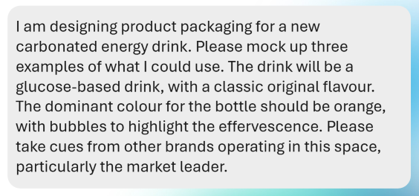
A greater risk for inadvertent infringement arises where an AI tool reproduces IP protected content in its output without the AI user prompting it to do so. An example discussed at the conference was a product packaging designer using an AI image generator to mock up designs. Here we prompted an AI image generator to create packaging designs for a new energy drink:
Prompt to generate packaging designs for new energy drink.
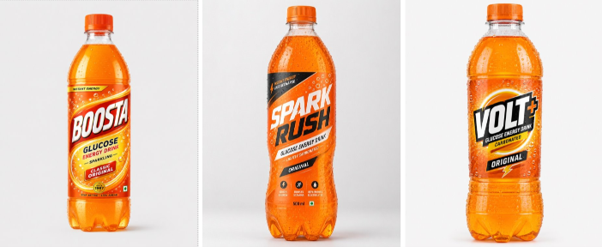
When writing this AI prompt, we expected that the AI tool might take cues from Lucozade Energy. As expected, the mock up packaging examples generated by AI included similar design elements to that brand:
AI generated output for energy drink packaging.
Given the prompt, these product mock ups might be taken to an in-house legal team to ask if they are too close to Lucozade from a trade mark, passing off or copyright perspective. While an in house legal team may consider that these product packaging mock ups are unlikely to infringe the Lucozade UK trade marks, that may create a blind spot. What might be less obvious is that the AI-suggested product names Boosta, Spark Rush and Volt, seemingly not considering any infringement of other trade marks, such as those of “Boost”, “Blue Spark”, “Adrenaline Rush” and “Volt” .
The ease of replicating a business or application with AI
Most attendees at the conference were aware of the capabilities of AI chatbots or image generation tools such as ChatGPT, Gemini and Copilot. There was however less familiarity with some of the full-stack AI app builders, such as Bolt, Lovable and Replit. These are AI tools that are able to generate an entire working software application or website from a text prompt or natural language description. Such tools can not only generate the look and feel of a user interface for an app or website, but can also create the behind-the-scenes code that processes data, the databases which save user data, and are able to deploy the app live on the internet. These tools are powerful and inexpensive – in preparation for the conference presentation we tested one such AI tool’s ability to generate infringing websites, each costing less than a cup of coffee.
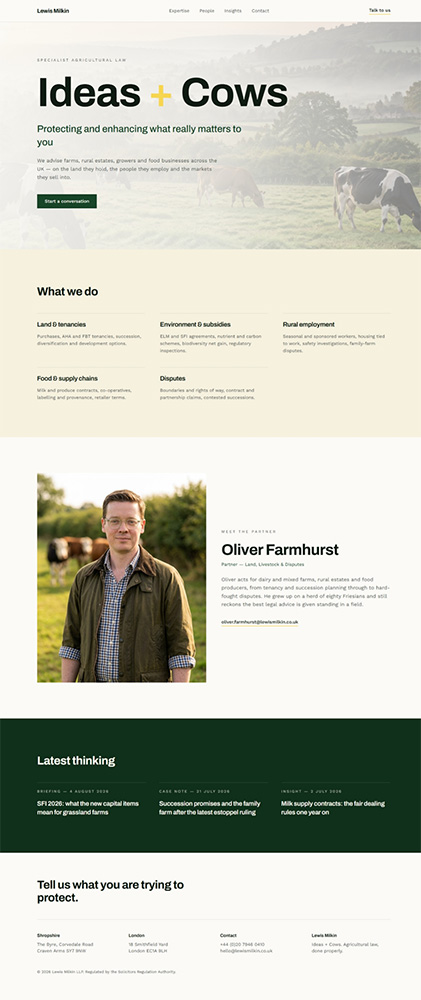
By way of example, we prompted the AI tool to create a law firm website for “Lewis Milkin” – a specialist agricultural law firm, taking inspiration from our own Lewis Silkin website. The AI tool was able to rapidly generate a working website, modifying our firm “Ideas + People” tagline into “Ideas + Cows” and generating a deepfake image of the firm’s leading partner “Oliver Farmhurst” providing legal advice surrounded by a “herd of eighty Friesians”. A screenshot of the website is below (click to expand).
IP lawyers have long cut their teeth assisting clients with scam websites impersonating genuine brands through the domain name dispute process, cancelling domain names that incorporate a brand owner’s trade marks that are being used for illicit gain. In the past such scam websites took time and effort for scammers to create, but now with the use of these AI tools such websites can be generated nearly instantaneously – causing a common legal issue to become a challenging issue at scale. This means that companies will increasingly need to have an IP strategy dealing with such AI clones, and partner with law firms or providers who are proactive in searching out and taking down such websites using carefully calibrated portfolios of IP rights.
"Lewis Milkin" - fictional specialist agricultural law firm.
What is our practical advice for clients building or using AI-generated outputs?
Our key advice for businesses deploying AI tools includes:
Involve meaningful human authorship if wanting to protect AI outputs: You will have a stronger copyright claim if you can establish that AI was used as a tool by the human author, rather than there being a purely AI generated work with no real human creative input.
An AI policy may not be enough: A policy on AI use and documenting the creative process is a useful starting point, but is of less value if it is not followed.
Clear AI outputs from IP infringement risks: There is a risk that an AI output may infringe third party IP rights, even if it was not explicitly prompted to copy a competitor. Make sure your clearance process is adequate.
Know your indemnity and insurance: What does your contract say about allocating risk of IP infringement in AI-generated outputs? What is the contractual indemnity, and what insurance do you hold?
Explore more from AI Agenda 2026
On 16 September 2026, we hosted AI Agenda 2026 for senior leaders, legal experts and innovators exploring what it takes to deploy AI safely, strategically and at scale. Explore all the insights from other sessions - covering topics from agentic AI and governance to IP, procurement, litigation and leadership.