


Where there's smoke, there's usually fire, but in the world of smoke-detector testing, the whole point is to simulate one without the other. In No Climb Products Ltd v Gas Safe Europe Ltd [2026] EWHC 908 (IPEC), handed down on 22 April 2026, HHJ Hacon considered whether Gas Safe's DetectaReach® product infringed No Climb's European Patent 2,265,516 B1 in the UK, and whether that patent was valid. The judgment finds both infringement and validity.
Background
Smoke and gas detectors need regular testing to make sure they still trigger an alarm. No Climb's patent solves a practical problem: how to spray a test aerosol at a ceiling-mounted detector from below, while keeping the spray far enough away. Spraying from too close can leave residue that stops the detector working properly.
The patent's key idea is a "spacer" that moves between a compact position for carrying and storage, and an extended position that sets the right test distance. The patent shows various embodiments of this concept, including a four-part telescopic spacer (sold by No Climb as the "Sabre") and a cylinder that holds a removable aerosol can. These embodiments can be seen respectively in Figures 1 and 2 below.
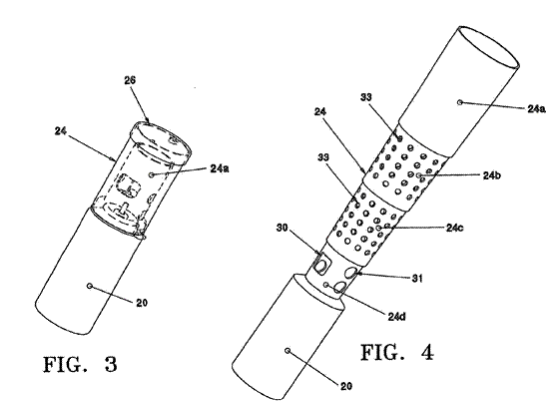
Figure 1: Patent Figures 3 and 4 – telescopic spacer embodiment ("Sabre" product)
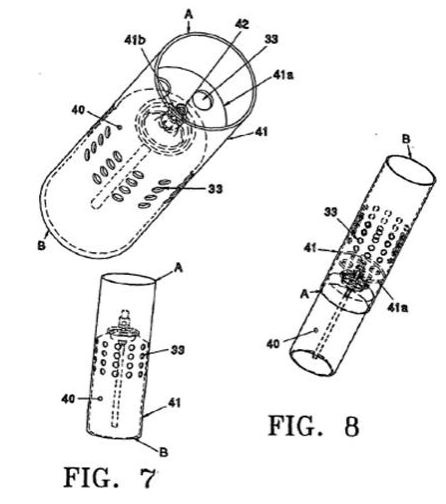
Figure 2: Patent Figures 7 and 8 – cylinder/spacer embodiment with removable container
Clearing the air: claim construction
Claim 1, the primary claim under scrutiny, reads:
Testing apparatus for testing a gas and/or combustion product detector, comprising:
a container arranged to contain a material dispensable as a spray, aerosol or particulate through an outlet aperture,
wherein the material dispensable as a spray, aerosol or particulate is representative of a gas and/or combustion product;
characterised by a spacer member,
wherein the spacer member is moveable between a first position which is convenient for carrying and/or storage and a second position which determines a minimum distance between the outlet aperture and the detector.
Construction of the claim language turned on two points, both relating to the spacer. In this regard, Gas Safe argued that the spacer must (a) be telescopic and (b) stay permanently attached to the container. However, these points were really just smoke and mirrors, and the judge rejected both arguments.
With respect to (a), Hacon asserted that Claim 1 only requires the spacer to be "moveable". A later, narrower claim (claim 5) adds telescopic compressibility as an extra feature and, as is well established, a narrower claim only makes sense if the broader claim didn't already require that feature. Further, some of the patent's own drawings show non-telescopic spacers, including ones that simply pivot. As such, the judge concluded that claim 1 did not require that the spacer be telescopic.
In connection with (b), the same logic applies, since claim 2 adds the fixed requirement separately, it was not already required by claim 1. In their arguments, Gas Safe additionally pointed to wording elsewhere in the patent describing a spacer fixed to the container, but the judge held this only described one preferred embodiment, not a requirement of the claim itself. For these reasons, Hacon concluded that it was not a requirement of claim 1 that the spacer stay permanently attached to the container.
This is a useful reminder that courts will not read extra limits into a claim from the specification's preferred examples, nor from narrower dependent claims.
Direct Infringement
Given the construction above, Gas Safe accepted that DetectaReach®, a plastic housing plus aerosol can (see Figure 3 below), falls within claim 1. In this connection, the housing has a wider part and a narrower part. The can sits in the wider part when stored, and is inserted into the narrower part when in use, at which point the housing acts as the spacer.
It was also asserted that DetectaReach® infringed claims 8 and 9 of the patent. These claims add further features relating to the space sections, based on controlling whether the user can activate the spray, blocking the trigger when compact, and permitting it when extended. Gas Safe argued that claims 8 and 9's reference to "sections" meant something specific; nesting telescopic parts like those of Figure 1. The judge disagreed, indicating that "section" is an ordinary word, and the wider and narrower parts of the housing both qualify. Therefore, both claims were infringed.
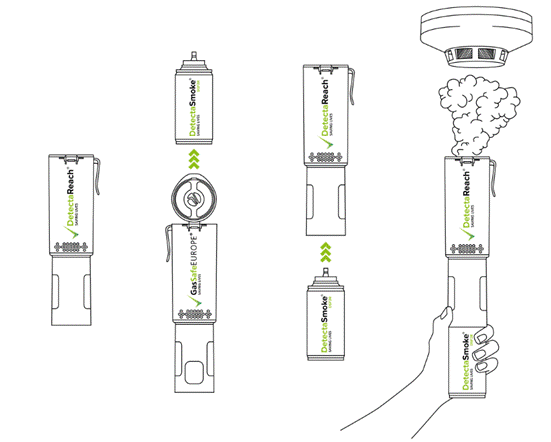
Figure 3: Gas Safe DetectaReach® instruction manual diagram showing wider and narrower housing sections
Indirect Infringement and the "Staple Commercial Product" Defence
No Climb also claimed Gas Safe's "DetectaSmoke®", a replacement aerosol can for DetectaReach®, infringed under section 60(2) of the Patents Act 1977, which covers infringement through supplying a key part of a patented invention.
The only real dispute was over knowledge: did Gas Safe know, or should it have been obvious, that DetectaSmoke® cans would be used to work the patented invention? The smoking gun was the packaging itself, which stated the can is "for use with DetectaReach® reusable delivery system" and should be replaced when empty. That wording alone was enough to establish knowledge, a reminder that a replacement part's own label can readily supply the knowledge needed for this kind of claim.
Gas Safe argued that DetectaSmoke® is a "staple commercial product", which relates to something so commonly used for many purposes that supplying it can't be regarded as infringement. The judge disagreed. DetectaSmoke® has one real use (testing smoke and gas detectors), and the fact that an empty can could theoretically be repurposed didn't change that. A product only counts as a staple commercial product if it is genuinely, commercially, put to a variety of uses. In other words, Gas Safe's defence went up in smoke.
Validity
Having failed to extinguish No Climb's infringement case, Gas Safe argued claim 1 lacked novelty and was obvious in light of three earlier patents: Ackerman, Wantz and Spohn. It accepted that if claim 1 survived, claims 8 and 9 would too.
On novelty, the experts agreed that a "spacer" only makes sense in an "open" testing system. That is, a testing system that sprays freely towards the detector and which contrasts with an "enclosed" system that seals the detector inside a cup or chamber. Ackerman and Spohn are both enclosed systems with no spacer, so claim 1 was novel over both because an enclosed system can't disclose a feature that only exists in open systems. Wantz does disclose a spacer (a tube), but nothing in it clearly shows a compact position for carrying or storage. Therefore, claim 1 was novel over Wantz too.
On inventive step, Gas Safe's expert admitted in cross-examination that he had never actually been asked to compare the prior art with claim 1, and he also appeared to have misunderstood the claim, wrongly assuming the "first position" meant the whole device being placed in a storage bag. That left Gas Safe's case with no real expert support. No Climb's expert gave unchallenged evidence that neither Ackerman nor Spohn would have led a skilled person to think of a moveable spacer at all, and that Wantz's focus on reaching far-away detectors with a bulky tube and pole would not have suggested a compact spacer either.
The judge accepted that evidence, despite spotting some tension in its reasoning, since it was unchallenged and not obviously wrong. Claim 1 was held not obvious over any of the prior art.
Conclusion
The patent is valid, and both DetectaReach® and DetectaSmoke® infringe it. No Climb won on every point: its simple spacer idea was neither anticipated nor made obvious by earlier patents focused on enclosed systems or bulky reaching devices.
For Gas Safe, the alarm has gone off. The case is a reminder that trying to read limits into a claim from dependent claims or preferred examples rarely works, and that the "staple commercial product" defence offers no shelter when a replacement part has one clear, patent-related use.
No Climb can rest easy: simulated smoke needs no real fire, but its rivals will need a different way to reach for the detectors.

