


When conditions at sea shift quickly, the readability of an onboard gauge can be the difference between safe passage and running aground. The same might be said of patent law – in the UK, when the Supreme Court hands down new decisions, applicants (and the UKIPO) need to be able to read the direction that has been set with enough clarity and reliability to navigate the new landscape.
A recent UKIPO decision (BL O/0673/26) has given patent practitioners an initial bearing on how the Supreme Court's landmark Emotional Perception AI ("EPAI") decision will be applied, in practice, to claims involving computer-implemented inventions. Interestingly, the Hearing Officer's decision threw the Examiner's analysis substantially overboard and charted a markedly different course through the intermediate step of the EPAI test.
Background
The patent application (GB 2216358.8), filed by maritime sensor specialist FLIR Belgium BV, relates to computer displayed (virtual) dial gauges for marine navigation displays. The invention seeks to solve the problem of traditional static dial gauges wasting display real estate by showing the full range of possible values. By way of example, a traditional true wind angle (TWA) dial gauge may display a full range between 0-360° at once, whereas a user may only need to monitor a narrow window having small fluctuations around the current wind angle reading.
To solve this, the claimed invention displays only the relevant segment of the virtual dial using a segment view of the total range view based on current sensor data (see Fig. 3A), which can pan to show a different segment (see Fig. 3B) when the monitored value crosses a threshold, thus maximising visibility of the relevant portion of the gauge. A programmed hysteresis delay prevents the display from flickering when the monitored value oscillates near the maximum or minimum displayed boundary.
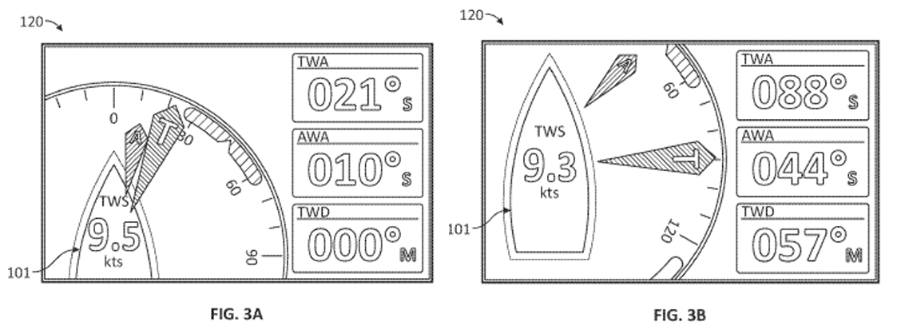
Figures 3A and 3B of the application as filed
During examination, the Examiner had raised objections under the existing Aerotel/ Macrossan framework for assessing excluded subject matter, asserting that the invention was excluded from patentability under Section 1(2) of the UK Patents Act as relating to a computer program and presentation of information "as such". However, in February 2026, the Supreme Court handed down its landmark decision in Emotional Perception AI Ltd v Comptroller General [2026] UKSC 3, which rejected steps 2-4 of the Aerotel approach and replaced them with a new approach based on the EPO's Enlarged Board of Appeal's "Duns principles" set out in T 0154/04 and applied in G1/19. For a more detailed look at the Emotional Perception decision, readers should take a look at our previous articles here, here and here.
The Examiner therefore re-assessed the application under the new EPAI framework, but maintained inventive step objections, having filtered out most of the claim features as presentations of information "as such". Consequently, the Applicant requested a hearing before a UKIPO Hearing Officer who had not previously been involved in examining the application.
The EPAI Test
The Supreme Court's decision steered UK patent law into alignment with the EPO's well-established approach under G 1/19. In place of the Aerotel/Macrossan approach, the new EPAI test is as follows:
(i) Properly construe the claim.
(ii) The "any hardware" test: does the claim involve the use of any hardware, and thus have technical character?
(iii) Perform the "intermediate step": determine which features contribute to the technical character of the invention as a whole, and filter out those that do not.
(iv) Assess novelty and inventive step based only on those features that survive step (iii).
The key change is step (iii), which requires a feature-by-feature analysis of which claim features contribute to the technical character of the claim. Features that are excluded matter "as such" are those that do not interact with the technical character of the invention and such features are discarded before the novelty and inventive step assessment begins. Recent statutory guidance issued by the UKIPO confirms that a similar approach to the EPO should be taken in this regard, directing Examiners to the EPO Guidelines rather than the existing guidance in the UKIPO Manual of Patent Practice.
The Examiner's Re-assessment
In the Examiner's reassessment of the invention following EPAI, a fairly aggressive approach was taken to the filtering exercise of step (iii). In particular, nearly all of the features relating to the gauge were stripped out as relating to a presentation of information "as such", including the segments, the switching behaviour between segments, the hysteresis delay, and the panning transition. This essentially left only a computer-implemented method of dynamically updating navigation information on a vehicle user display based on detected sensor data for the assessment of novelty and inventive step.
In response, the Applicant argued that many of the stripped-out features do contribute to the invention's technical character, since dynamically updating the displayed gauge segment in response to sensed data reduces user distraction and thus ultimately improves vehicle operability and user safety. The Applicant further argued that the hysteresis delay is technical as it prevents unwanted display switching and ensures that only a stabilised change triggers a transition.
The Hearing Officer's Analysis
The Hearing Officer performed their own detailed feature-by-feature analysis and reached a markedly different conclusion to the Examiner. Anchoring their reasoning in EPO case law, and particularly the Enlarged Board's approach in G1/19 along with several EPO Technical Board of Appeal decisions, it was found that the Examiner may have been somewhat overzealous in their initial assessment.
After providing some commentary on claim construction (which was not in contention), the Hearing Officer agreed that the "any hardware" test was passed due to the inclusion of various technical features including a vehicle, display, logic device and sensors. Moving onto the "intermediate step", the Hearing Officer found that the majority of the claim features do contribute to the technical character of the claim. In particular, the Hearing Officer identified that those features relating to sensed data being used for displaying navigation information went beyond abstract data input and output because they represent a functional link between real-world sensor data and the operation of a navigation display. The features concerning which segments are displayed or excluded based on current sensor values were also retained, given their connection to sensed data and technical purpose.
Further, the Hearing Officer found that the hysteresis delay feature contributes to technical character, since preventing flickering on a navigation display reduces distraction for the vessel operator and therefore has a technical purpose beyond mere aesthetics. This conclusion was reached on the basis of another EPO decision (T 0505/18) where the EPO held that suppressing advertisements near road intersections to reduce driver distraction constituted a technical effect contributing to safer vehicle operation. This is a particularly significant finding as it may suggest that features designed to reduce operator distraction in safety-critical environments can survive the filtering exercise.
Only three features were filtered out as being non-technical. The panning transition was held to be merely a "visually appealing transition", and the features relating to the inclusion of the "centre" of the dial were likewise held to be non-technical details of how to present the gauge visually, with no functional or safety-related purpose.
Next Steps
The Hearing Officer did not determine inventive step. Instead, the case was remitted back to the Examiner to apply the Pozzoli test properly with the corrected set of filtered features. It was noted that the Examiner's earlier inventive step assessment had not properly followed Pozzoli as there had been no discussion of the skilled person, no identification of common general knowledge, and no structured analysis of the differences between the claim and the prior art.
In a helpful steer for the next stage of examination, the Hearing Officer identified US 2010/0026688 (relating to a wind gauge and filed by Garmin) as likely being the closest prior art and noted that the key difference may lie in the "predetermined time delay" aspect of the hysteresis.
Conclusion
In the wake of EPAI, many patent practitioners have wondered how the new test will bring about different outcomes at the UKIPO. This decision is notable as one of the first detailed applications of the EPAI test at the UKIPO. It demonstrates that the new framework can produce materially different results from the old Aerotel approach, and that Hearing Officers are prepared to take a more nuanced, feature-by-feature view than UKIPO Examiners may initially adopt. In this case, the new approach has shifted the balance in the Applicant's favour. For practitioners navigating these new waters, the following takeaways are worth logging in the chart:
Challenge aggressive filtering. The Examiner's instinct was to strike out most features as "presentation of information" during the intermediate step. The Hearing Officer disagreed substantially. The EPAI test demands a careful, feature-by-feature analysis in the context of the whole claim.
Emphasise links to physical reality. Features that represent a functional connection between real-world sensor data and display behaviour are more likely to be considered technical. The Hearing Officer placed significant weight on the fact that the gauge behaviour was driven by actual sensor values rather than being a purely abstract or decorative choice.
Safety arguments can be technical. The reasoning in Blackberry (T 0505/18) was persuasive in that reducing operator distraction in a vehicle context provides a technical effect. If an invention's display features serve to reduce distraction or improve safety in an operational environment, ensure this is argued explicitly.
Purely aesthetic features remain excluded. The panning animation and dial-centre features were filtered out because no technical purpose was articulated. Therefore, if a feature has a function beyond mere aesthetics, include this at the drafting stage and highlight this during prosecution.
Know your EPO case law. The Hearing Officer drew heavily on multiple EPO Technical Board of Appeal decisions, including Xanavi (T 0651/12), Blackberry (T 0505/18) and Cleveland (T1802/13), to guide their application of the intermediate step. Under the new EPAI framework, fluency in the EPO case law relating to technical character will be necessary to successfully navigate UK prosecution.


