


The Home Office released an updated draft Employer's guide to right to work checks on 11 September 2026. This indicates engagement with stakeholders on clarifications to the guidance is ongoing ahead of the expanded right to work scheme goes live from 1 October 2026. In this article we summarise what's changed from the 16 July 2026 draft.
You can find the 11 September 2026 draft here, and the superseded 16 July 2026 draft here.
Significant differences between the two versions are summarised below.
Further guidance on when arrangements are (or are not) in scope
A new section has been added from page 14 of the guidance, headed 'Assessing working arrangements'. This section sets out factors to consider when seeking to determine whether a direct employment relationship (as defined for right to work purposes) or arrangements within the scope of extended liability might apply.
The Home Office states that the contractual description or label applied by the parties won't, by itself, determine what responsibilities are applicable under the right to work scheme.
Eight factors are identified for consideration; however, the Home Office hasn't indicated whether these point towards or against responsibilities being applicable (and, if so, whether under direct or extended liability). They are therefore likely to be of limited practical assistance to businesses unless further elaborated.
Revised extended liability flowchart
The flowchart on page 43 of the guidance now has a note in the first text box, under the question 'Is the person providing or arranging work or services for another party?':
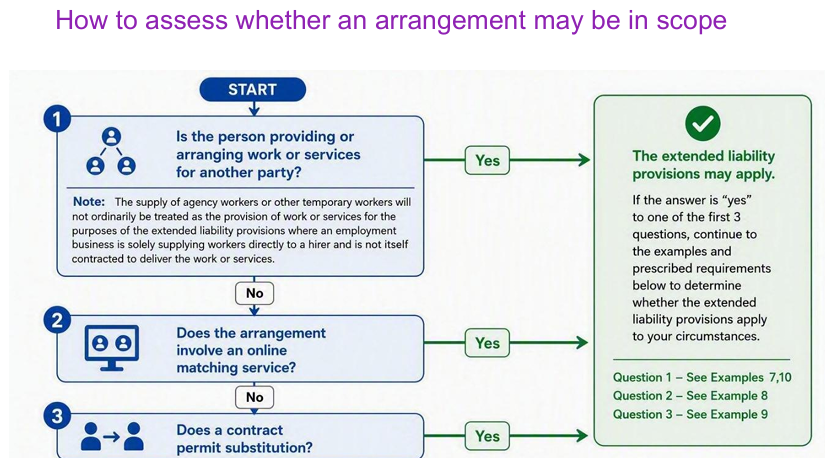
This provides an important insight into how the Home Office considers agency workers in the context of extended liability. Note that the revised flowchart hasn't yet been added to the accessible version of the draft guidance; however, we anticipate this will be corrected by the Home Office shortly.
Additional clarifications of the intended scope of the guidance
Examples of clarifications include:
- Confirmation that the scheme doesn't apply to arrangements where the work or services are to be carried out outside the UK;
- Clearer confirmation that the right to work scheme doesn't apply to individuals operating an independent business either under their own name or through their own company and who contract directly with clients or customers to provide goods or services; and
- Confirmation that the examples contained in the guidance are not intended to be exhaustive.
Confirmation that the prescribed requirements for extended liability only apply to contractual arrangements starting on or after 1 October 2026
The guidance now states on page 14 that a person (i.e. ordinarily a business) seeking to establish a statutory excuse against extended liability is only required to comply with the Home Office's prescribed requirements for this where the relevant contract is entered into on or after 1 October 2026.
This will apply to contracts in the following general (non-online matching service) scenarios:
- Where a 'person' has been engaged to provide work or services to a third party, and enters into a contract with another 'employer' to provide or arrange for the delivery of work or services, such as by providing workers to carry out the work – in this case the relevant contract must comply with the Home Office's prescribed contractual terms and conditions (written statement); ot
- Where a person enters into a contract with an independent sub-contractor – this is because this type of contract will have a right of substitution and will therefore require the inclusion of prescribed contractual provisions to implement substitution controls.
It will also apply to online matching services' contracts where:
- A service provider enters into a contract with a client or customer it has been matched to via the online matching service, and the work or service is due to start on or after 1 October 2026 – in this case the contract between the online matching service and the service provider must comply with the Home Office's prescribed contractual terms and conditions (written statement); or
- An individual service provider is engaged by an online matching service provider on or after 1 October 2026 under a contract that includes a right of substitution – in this case contractual provisions implementing the Home Office's prescribed substitution controls will be required.
Clarification of when right to work checks may be delegated
The July 2026 version of the draft guidance included text stating that an employer may delegate responsibility for carrying out manual right to work checks to individuals or members of staff acting on its behalf, including workers, agency workers, or other workers working under its control, direction and who are accountable to it.
This text has been moved in the September 2026 version, to make it clear that delegation is permitted for all types of right to work check (not just manual).
Further text has been added noting that right to work checks carried out for other purposes (such as part of an application for an operating licence or other regulatory approval) will not establish a statutory excuse.
Additional guidance about possible impersonation and imposters
Further text has been added to note that any doubts an employer has about an individual's identity or right to work documentation should be raised with them in a sensitive and proportionate way. Employers can:
- Ask the individual for further information to address any anomalies found during the checking process;
- Seek independent legal or HR advice; and
- Read the 'Support' section of the guidance for more information.
The circumstances in which concerns arise can vary widely. We would suggest that businesses train the staff responsible for carrying out right to work checks on the business's best practice for both giving individuals a reasonable opportunity to prove their right to work, and ensuring the safety of staff.
Additional guidance on using a registered RtW DVSP
In practice, right to work checks offered by RtW DVSPs are commonly rolled into the broader services of a pre-employment screening service provider or other organisation. Text has been added to confirm this is acceptable provided the organisation clearly and accurately states it is working with a certified and registered RtW DVSP, including identifying which one is being used.
The information that must be provided to the employer by the RtW DVSP for document checks and facial recognition checks has substantially been amended to:
- Require that the name of the RtW DVSP, as it appears on their certificate, is shown;
- Require the inclusion of a link to the digital verification services register (trust mark details are optional); and
- Allow a greater range of response types to certain mandatory fields, to accommodate variation in how positive and negative findings are expressed by different RtW DVSPs.
Need more help?
Although the expanded right to work scheme is due to launch imminently, there are still points for clarification. The Home Office is continuing to work with stakeholders to make further improvements to the guidance, which we are participating in. We will continue to provide updates as further information becomes available.
If you have specific queries relating to your business, please get in touch with our Immigration Team.


