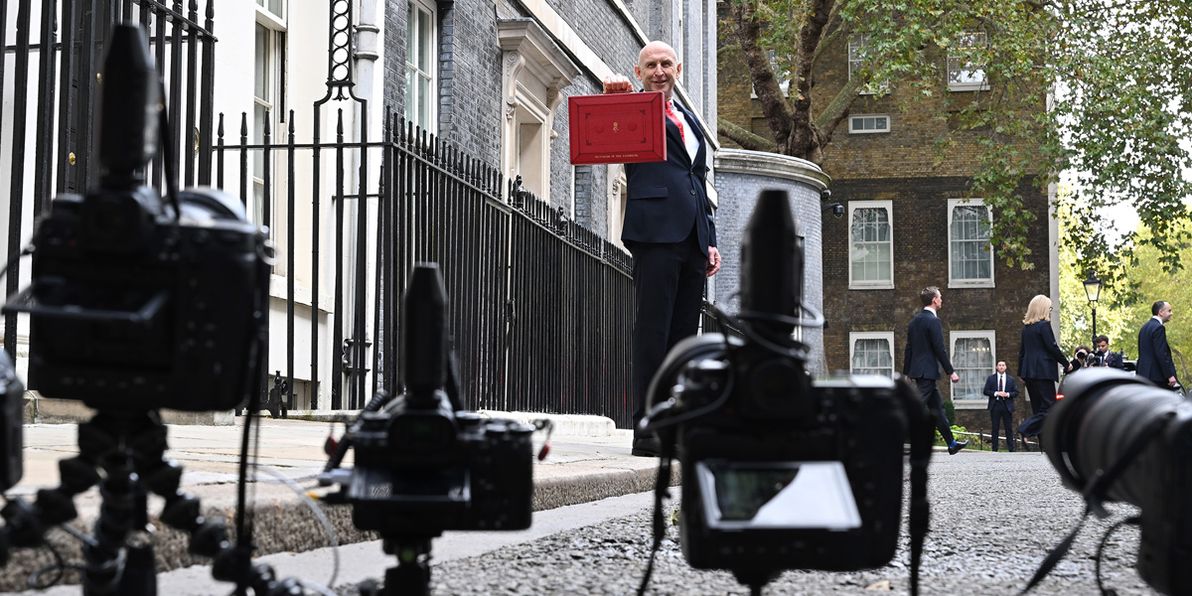
The Autumn Budget, delivered by John Healey on 28 October 2026, was one of the quieter budgets in recent times, from an employment tax perspective at least. In this article, we sum up the (few) upcoming employment tax changes.
Mileage allowance payments
The temporary 55p per mile approved mileage rate for the first 10,000 business miles in cars and vans, announced in May, is being made permanent with effect from 6 April 2026. The rate above 10,000 business miles will increase from 25p to 35p from 6 April 2027. Employers paying mileage allowances should update their expenses policies and payroll systems accordingly.
Company car percentages
Appropriate percentages for 2030-31 have been set at 1 percentage point above 2029-30 rates across all bands. Zero-emission vehicles will rise from 9% to 10%, cars emitting 1 to 50g CO2/km from 19% to 20%, and all other bands by 1 percentage point, subject to a maximum of 40%. The Budget also refers to the "potential for ULEV SalSac reforms" but gives no detail; employers with electric car salary sacrifice schemes should watch for further announcements.
Van benefit
There is no structural change, the van benefit charge and the car and van fuel benefit charges will be uprated in line with CPI from 6 April 2027.
Mandatory payrolling of benefits
The Budget confirms the previously announced phased timetable. Mandatory payrolling of company cars, vans, fuel and medical benefits will apply from 6 April 2027, with remaining benefits in kind following from 6 April 2028. With April 2027 now only months away, employers should ensure their payroll software and processes are ready for real-time reporting of these benefits.
Immigration Skills Charge and Certificate of Sponsorship fees
The government will legislate in Finance Bill 2026-27 so that an employer’s payment of the Immigration Skills Charge (ISC) or a Certificate of Sponsorship (CoS) fee is not treated as a taxable benefit in kind, for payments made on or after 28 October 2026.
The Budget describes this as "a change to the tax treatment" of these costs, and it applies to payments from 28 October 2026. Our view is that as ISC and CoS fees must always be paid by the sponsoring employer and cannot be passed on to or reimbursed by the worker, they should be treated as giving rise to a benefit in kind, but HMRC has recently been challenging that position in employer compliance reviews. Note that the measure does not cover the Immigration Health Surcharge, which can still be a taxable benefit in kind for in-country applications.
See our earlier article on this point, here: Immigration costs as taxable benefits in kind what UK sponsors need to know
Employment expenses
The £2,500 threshold above which employees must use Self-Assessment to claim tax relief on non-reimbursed employment expenses will be removed from 6 April 2028. More claims will be able to be made through PAYE, with evidence required before relief is given. The government will keep under review whether to mandate the PAYE route for those claiming only employment expenses.
Separately, from April 2028 the Benchmark Scale Rates for domestic subsistence will be modernised and the Overseas Scale Rates will be replaced with a simpler tiered approach.
Image rights
As announced at Budget 2025, the government will legislate to clarify that image rights payments related to an employment are taxable as employment income, in the same way as wages. Implementation has been deferred by a year to 6 April 2028 to give affected sectors more time to adjust. Legislation will be included in Finance Bill 2026-27.
Termination payments
The Budget states that the government is "clarifying the legislation around the tax treatment of termination payments", with minor changes to the rules that apply to gains made by non-resident close companies that are attributed to UK resident individuals, trusts and companies. These changes will be introduced in the Finance Bill 2026-27 taking effect from 28 October 2026. No further detail is given in the Budget document. We will update you when we know more.
For more on the Budget generally, see Matt Rowbotham's view, our Head of Tax, on all the key takeaways, for a detailed look at the changes to share plans, see Michael Birchall’s analysis of ‘EMI 2’ (amongst other changes).